Proteus Review 2026: Build a Domain Business for $12.90
Editor & Lead Reviewer, ToolsProZone
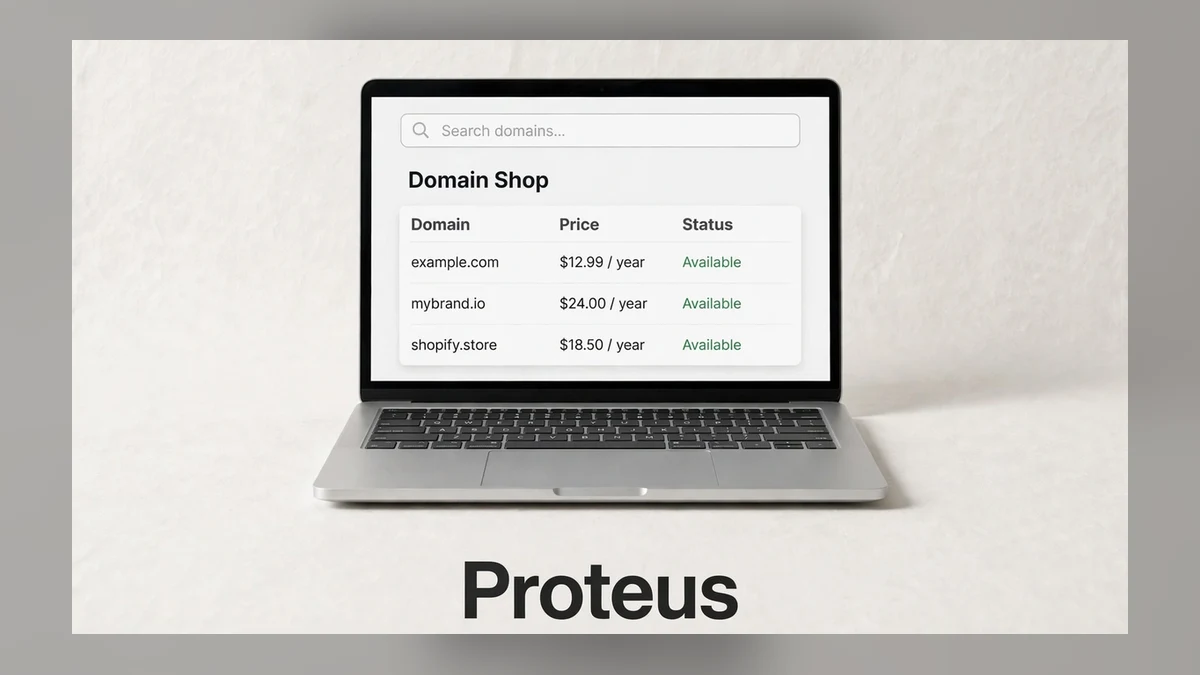
Domains are digital real estate. Every new business needs one. Good names sell for hundreds or thousands of dollars. So the pitch behind Proteus sounds tempting. Pay $12.90 once. Get a ready-made domain shop. Let AI find buyers, send the emails, and handle the sales. You keep the profit.
It is a neat story. The question is how much of it survives contact with reality. Can a $13 app really turn you into a domain registrar? What does “AI-powered” actually cover? And what does the full funnel cost once the upsells start?
Disclosure: We may earn a commission if you buy through our links, at no extra cost to you.
How we reviewed it: We did not run the app ourselves. Our findings come from independent reviews read on 29 November 2026. We used EntrepreneurPicks, TechTonic Reviews, Aditya Tomar, TikaReview and two long-form reviews by Eden Morgan, plus the vendor’s JV materials. Sources disagree on the launch date, the vendor name, and even the upgrade list. We report those conflicts instead of picking the friendliest version. Where a claim comes only from the vendor, we say so.
Proteus is a cloud-based platform that lets you run your own domain-selling business. It builds a branded domain shop, lists domains for sale, and uses AI tools for research, outreach and follow-up. It launched in March 2025 from Mike McKay, Calin Loan and Radu Hahaianu, and sells from $12.90 one-time with a 30-day money-back guarantee.
What It Is
Proteus is a cloud-based platform for selling domain names. You get a ready-made online shop under your own brand. Customers search for domains, pick one, and pay through the shop. The platform handles the listing, the checkout, and the delivery. AI tools sit on top. They suggest domain names, find expired domains worth buying, write sales emails, and follow up with leads.
The core idea is simple. Instead of buying domains from GoDaddy or Namecheap, you sit on the other side of the counter. You sell domains to other people. The vendor calls this running your own registrar business. That wording matters. We come back to it below, because one source says it is not quite what it sounds like.
Proteus launched in March 2025, from vendors Mike McKay, Calin Loan and Radu Hahaianu. The three are known names in the launch-software world. They have released a string of low-priced AI tools through the same networks. That history cuts both ways. Launches run smoothly. Support and long-term updates are harder to judge from a launch page.
First, Make Sure You Have the Right Proteus
Searching for “Proteus review” returns three different products. This causes real confusion, and no competing review clears it up.
The first is this one. An AI domain-selling platform. The second is Proteus.ai, a video tool that turns a topic into a faceless video with a script, visuals and voiceover. The third is Proteus by Labcenter Electronics. That one is circuit-design software for engineers, and it has existed for decades.
They share nothing but a name. If a review talks about video generation, PCB layouts, or SPICE simulation, it is reviewing a different product. This review covers the domain platform only. The same warning applies to the app stores. Check the vendor name before you pay.
Key Features
Ready-made domain shop. This is the heart of the product. You pick a brand name, and the platform builds a storefront. It comes pre-loaded with domains across common extensions like .com, .net and .org. Customers search, buy, and pay. The vendor says setup takes minutes. One reviewer reports a shop live in under 15 minutes.
AI domain name generator. The tool suggests brandable domain names. The vendor says it uses ChatGPT 4.5 technology. That claim is unverified. No reviewer has shown the generator working or compared its suggestions with a free tool. Treat it as a brainstorming aid, not a secret weapon.
Expired domain tools. Proteus includes access to expired domains, with AI suggestions for which ones hold value. One source cites 200,000+ expired domains. Expired names can carry traffic and backlinks. That is why flippers want them. The hard part is finding the good ones before everyone else does. More on that below.
1M+ business leads. The launch included a database of over a million business leads to market domains to. The number sounds impressive. The quality is the question. A million cold contacts are worth little if the emails bounce, or if the list is old. No reviewer has tested the list. Cold outreach also carries spam and privacy risks, which no competing review mentions.
Built-in email marketing AI. The platform writes and sends sales emails and follow-ups. It can also plug into an autoresponder. For a beginner, this removes a real barrier. Writing outreach by hand is slow and awkward. But AI-written cold email is still cold email. Response rates stay low, and that is normal.
Hosting and SSL upsells. Your shop can also sell hosting, SSL certificates, and SEO services. This is where the money gets more interesting. A domain sale is a one-off payment. Hosting renews every year. One reviewer reports that about 35% of their domain buyers also bought hosting. That figure comes from a single affiliate review, so treat it as a story, not a statistic.
Commercial licence included. The front end includes the right to sell domains and services to clients and keep the profit. That is standard for this kind of launch. Note the wrinkle, though. The funnel also sells a separate Reseller licence for $197. The vendor has not explained clearly what the front-end licence covers and what the $197 licence adds. If you plan to sell client work, ask support before you buy the upgrade.
99+ premium AI systems. The launch materials claim 99+ premium AI systems are built in. No source explains what these are. Are they separate AI models? Are they templates? Are they tools inside the dashboard? Nobody says. A number that big, with no detail behind it, is marketing. Ignore it until the vendor explains it.
How It Works
Step one: buy access and create your account. The platform runs in the browser. Nothing to install.
Step two: brand your shop. Pick a store name, set your payment details, and connect PayPal or Stripe.
Step three: stock the shelves. The AI fills your shop with domains, including expired names it flags as valuable. You can also add your own picks.
Step four: drive buyers. Use the built-in leads list, the email tools, or your own promotion. Social media and ads are the usual routes.
Step five: the platform handles the sale. Registration, transfer, and payment run through the system. You collect the margin.
That is the smooth version. The honest version is that steps three and four carry the whole business. Finding domains worth selling is a skill. Finding buyers is harder still. Software can speed up both jobs. It cannot do them for you.
Pricing
Prices below come from independent reviews — EntrepreneurPicks, TikaReview and Aditya Tomar — cross-checked on 29 November 2026. They agree on the front end and the main upgrades. Launch prices move, and coupons come and go. Treat these as a guide, not a quote. The checkout page is the final word.
Front End — Proteus: $12.90 one-time. You get the domain shop, the AI name generator, the expired-domain tools, the leads database, the email tools, hosting and SSL upsells, and the commercial licence. Two coupon codes are reported across sources: PROTEUS6 for $6 off, and PROTEUS30 for 30% off. Early-bird reports also mention $12 or even $8 pricing during the launch window. That window has passed.
OTO 1 — Pro Upgrade: $32.90. Adds an email autoresponder, a website builder, and unlimited features. This is the upgrade most buyers will feel. The front end has caps. The vendor does not publish them.
OTO 2 — Enterprise Plan: $62.90. Adds hosting reselling and premium support. This matters if you plan to sell hosting as a service. For a solo flipper, it is optional.
OTO 3 — Done-For-You Package: $39. A pre-built business setup. Useful if you want the shop configured for you. The value depends on how much of the setup you would do anyway.
OTO 4 — Reseller Rights: $197. Lets you sell Proteus itself as your own product and keep the full price. This is a business in itself. It only pays off if you can sell software, which is a different skill from selling domains.
OTO 5 — IMX Bundle: $97. A bundle of premium business tools. The contents are described vaguely across sources. Ask what is inside before buying it.
Buy everything and the total lands at about $441.70. The realistic buy is the front end plus Pro: $45.80. That is the combination that unlocks the autoresponder and removes the front-end limits.
One more thing. The purchase includes a 30-day money-back guarantee, stated consistently across every source we checked. That window is your real test period. Set up the shop, list some domains, send some outreach, and see what actually happens before the 30 days run out.
A note on the upgrade list. One competing review lists a completely different set of five upgrades. It names niche domain packs, a cold outreach booster, a flipping toolkit, a branding kit, and a coaching call. The prices differ too. Either the funnel changed after launch, or different affiliates were given different funnel maps. We used the Pro/Enterprise/DFY/Reseller/IMX list because three sources agree on it. Flag the conflict, and check the live funnel at checkout.
One-time payment from $12.90 · 30-day money-back guarantee
The Registrar Claim — Read This First
This is the section the other reviews skip, and it is the most important one in this review.
Proteus sells the idea that you become your own domain registrar. A real registrar is accredited by ICANN. Accreditation costs money, needs technical infrastructure, and takes time. A $13 app does not grant it. So what does Proteus actually do?
One source, TrueValueCheck, gives an answer the others avoid. It reports that Proteus is built on an older product, and that domains are registered through NameSilo. In that setup, you are not a registrar. You are a middleman. A customer buys through your shop. NameSilo registers the domain. You earn a commission, reported at around 10% on new customers.
That changes the math completely. A 10% cut of a $12 domain is about $1.20. You would need volume, or higher-priced sales, to make real money. It also changes the story. “Run your own registrar” sounds like a business. “Earn affiliate commissions through a white-label shop” is a smaller, more honest claim.
We could not verify the NameSilo claim independently. The vendor does not name its registration partner in the public materials we could check. But the claim fits the price. Real registrar infrastructure cannot be sold for $12.90. Until the vendor names its partner and its margins, treat “own registrar” as marketing language, not a fact. Ask support two questions before you buy: who actually registers the domains, and what margin do I keep on each sale?
The Expired-Domain Reality Check
The second claim worth a closer look is expired-domain flipping. The story goes like this. You buy an expired domain for $10 to $15. It already has backlinks and traffic. You sell it for $50, $500, or even $2,000. One reviewer reports buying an expired domain with backlinks for $12 that had once sold for over $800.
Good expired domains do sell for real money. The catch is the competition. Valuable expired names are hunted by drop-catching services and auction platforms. The best ones go to auction, not to a $12 registration. What remains at registration cost is usually the leftovers. Finding a gem takes research, patience, and often an auction budget.
The AI research tool can help you sort the list. It cannot create supply. A list of 200,000 expired domains sounds huge. Most of them are worthless. The skill is telling the few good ones apart from the rest. That skill takes time to learn, and no software teaches it in a weekend.
The income examples in competing reviews show the same gap. “Flip 10 domains a month at $50 profit each, add hosting upsells, and you earn $800 a month.” The arithmetic works. The assumption does not. It assumes you find 10 sellable domains every month, and buyers for all of them. No reviewer has published a month of real sales to back that up.
Pros
- Very low one-time entry price — $12.90 buys a working domain shop with no monthly fee for the software itself.
- Covers the whole workflow: shop, listings, payments, outreach and upsells in one dashboard.
- Hosting and SSL upsells add recurring revenue on top of one-off domain sales.
- Commercial licence on the front end, plus a 30-day money-back guarantee across all sources.
- Beginner-friendly setup — one reviewer reports a shop live in under 15 minutes.
Cons
- The “own registrar” claim is shaky. One source reports domains run through NameSilo with around 10% commission. That is affiliate income, not a registrar business.
- No independent reviewer has published hands-on results — every ranking review repeats the same launch materials.
- Sources conflict on the launch date (March 2024 vs March 2025), the vendor name, and even the upgrade list.
- The “1M+ leads” and “99+ premium AIs” claims are unverified, with no detail on quality or what the AIs actually are.
- Good expired domains are fought over at auction — the $10-to-$500 flip story skips the competition.
- Real costs sit outside the software price: every domain you register costs $10–$15, plus renewals.
Proteus vs the Alternatives
The usual comparison pits Proteus against GoDaddy, Namecheap and Flippa. It is a lopsided comparison, and it flatters Proteus. Those are not the same kind of product.
GoDaddy and Namecheap are real registrars. You buy domains from them at retail or wholesale rates. They also run reseller programs. A GoDaddy reseller storefront costs a monthly fee, but you sell real registrations with known margins. Namecheap has no reseller storefront of this kind. Flippa is a marketplace for buying and selling domains and websites. You list there and pay a success fee when something sells. It has real buyers, which is the part Proteus cannot promise.
The honest comparison is with other white-label domain shops and reseller programs. Dan (now part of GoDaddy) lets you list domains for sale with a landing page. Sedo and Afternic put your names in front of real buyers. Atom (formerly Squadhelp) helps brand and sell premium names. None of them charges $12.90. None of them hands you a shop, a leads list, and an email system in one box. That bundle is what Proteus sells. The question is whether the bundle’s parts are strong enough to matter. The shop is real. The leads list and the AI tools are unverified. The buyers are up to you.
We reviewed a related hosting and domain-adjacent tool separately — see our AI Hosting 2.0 review, or browse the full directory at ToolsProZone.
Who It’s For
This fits beginners who want a cheap way to learn the domain business. It fits affiliate marketers who want a second income stream to test. It fits agencies and web designers who can offer domain services to existing clients. And it fits anyone curious about expired domains who wants a low-cost place to start.
Who It’s Not For
Skip it if you expect passive income in the first month. Skip it if you want a real registrar business — this is not that, whatever the sales page says. And skip it if you dislike outreach. The leads list and the email tools only work if you use them, every week, for months.
Our Verdict
Proteus is a fair bet at $12.90, with eyes open. The shop is real. The price is low. The guarantee gives you 30 days to test it. For a beginner who wants to learn domain selling, that is a cheap classroom.
But the headline promise does not hold up. You are almost certainly not becoming a registrar. You are running a white-label shop on someone else’s rails, likely keeping a small cut of each sale. The leads list is unverified. The 99+ AI systems are unexplained. The income examples are arithmetic, not evidence. And the good expired domains are the hardest part of this business, not the easiest.
Buy the front end if you want to learn. Skip the $197 reseller licence until you have sold something. Use the 30 days properly. Set up the shop, list ten domains, send a hundred emails, and track what actually happens. Ask support who registers the domains and what your margin is. If the answers are clear and the shop works, keep it. If the answers are vague, take the refund. That test costs you time, not money.
Frequently Asked Questions
What is Proteus?
It is a cloud-based platform for running your own domain-selling business. It builds a branded domain shop, lists domains for sale, and adds AI tools for research, outreach and follow-up. It launched in March 2025 from Mike McKay, Calin Loan and Radu Hahaianu.
How much does Proteus cost?
The front end costs $12.90 one-time, with coupons PROTEUS6 ($6 off) and PROTEUS30 (30% off) reported across sources. There are five optional upgrades from $32.90 to $197, bringing the full funnel to about $441.70. Prices were cross-checked on 29 November 2026; the checkout page is the final word.
Does Proteus really make you a domain registrar?
Probably not in the legal sense. A real registrar is ICANN-accredited. One source reports Proteus domains are registered through NameSilo, with sellers earning around 10% commission. We could not verify that independently, so ask support who registers the domains and what margin you keep before you buy.
Is there a money-back guarantee?
Yes. Every source we checked states a 30-day money-back guarantee on the front-end purchase. Check the checkout page for the current terms before buying.
Can I make money flipping expired domains with Proteus?
It is possible, but harder than the sales page suggests. Valuable expired domains are usually caught by drop-catching services or sold at auction. The ones left at registration cost are often worth little. Expect research and patience, not quick flips.
Conclusion
Proteus solves a real problem: starting a domain business is confusing, and doing it by hand takes weeks. A $13 shop with AI help is a sensible way to learn the ropes. Just remember what it cannot do. It cannot make you a registrar. It cannot find buyers for you. It cannot turn a list of cold leads into income on its own. Buy it, test it hard for 30 days, and let the results decide.
Similar Posts